Community Buildings & Community Asset Transfer – Short Survey The Sheffield City Council is reviewing its Interim Community Buildings Policy, which includes: Community Asset Transfer (CAT): Long-term leasing or transferring ownership of council-owned buildings or land to community or third-sector organisations. Lease Terms: Up to 125 years, with asset transfers defined as leases over 25 years. Purpose of the Survey – To gather feedback from local organisations and individuals with experience or interest in using community buildings. – To shape future policy based on lived experience, best practices, and community needs. To ensure the approach supports sustainability, funding access, and local empowerment.
Time Commitment – The survey takes 5–10 minutes and is anonymous – Open to anyone involved in or exploring community building use or asset transfer. The survey will close on Monday 20th October 2025
Want to Talk Instead? The council welcomes direct conversations. You can contact Diane Owens at (diane.owens@sheffield.gov.uk) or call 0114 474 3635
Community Transport Customer Consultation Reminder
South Yorkshire Mayoral Combined Authority is launching a consultation aimed at current registered users and non-users of Community Transport (CT) Monday 14th July, for an opportunity for CT users and non-users to tell (SYMCA) what they think of the service and/or any barriers to using the service.
Registered customers who have not used CT for over 6 months will receive a paper copy of the survey and have until Sunday 24th August to complete and send back via the pre-paid envelope. This survey will also be available on the Travel South Yorkshire website or via the QR link.
South Yorkshire’s Mayor, Oliver Coppard, is seeking your views on his proposed priorities for the Police and Crime Plan, which sets out the policing priorities for South Yorkshire Police over the next five years. Have your say by filling in the survey before 31st January – https://bit.ly/4gvndVy
Raising Dementia Awareness Among Friends and Family
St Columba’s Church, Crosspool Saturday 20th April 2024 10am-12noon All Welcome
Speaker: Kathryn Rawling, Dementia and Wellbeing Manager at Sheffcare.
It’s estimated that by 2040 1.6 million people will live with dementia in the UK and approximately two-thirds of those people will live at home supported by a family member or a friend.
We have arranged a relaxed accessible session that will help us all understand memory loss and dementia better, from the perspective of both the person living with dementia and the carer.
Our speaker is Kathryn Rawling, Dementia and Wellbeing Manager at Sheffcare and she is passionate about helping friends and families gain meaningful knowledge and understanding about memory loss and dementia. She believes in looking for innovative ways to help anyone living with dementia to have as fulfilling a life as possible.
If you have a friend, a neighbour, or someone in your family living with memory loss or dementia and you’d like to know more, please come and join us. Kathryn is a warm and interesting speaker and there will be plenty of opportunities to ask questions. For further information, please contact: Briony Broome 07801 532 954 email:briony.broome@hotmail.co.uk Sue Stew 0114 2670 006 email:admin@stcolumbacrosspool.org.uk
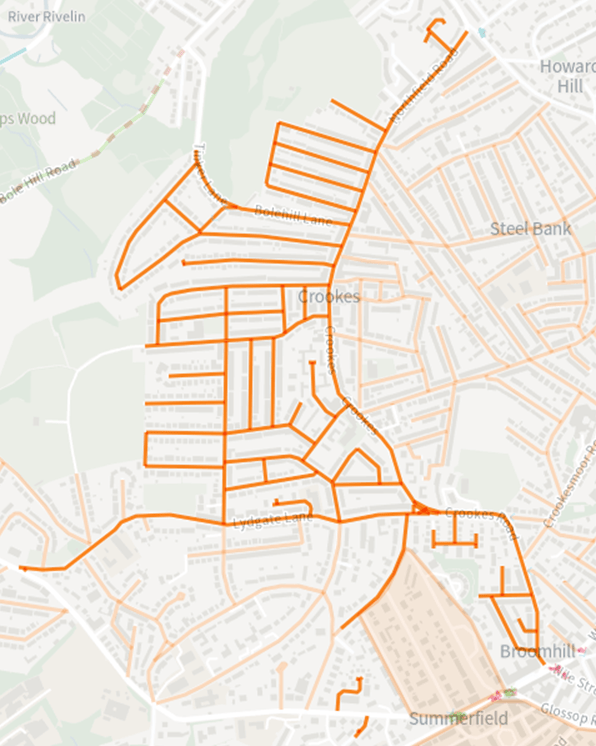
Councillors have issued a statement about the Active Neighbourhood trial currently running in Crookes and Walkley. The councillors support the aims of the trial but say the implementation has been ‘unpredictable’ and ‘confusing’. At a meeting with the Council’s Head of Strategic Transport and Infrastructure, (Tomorrow Tuesday, September 27th) they will call for more clarity to be given on the trial and for local residents to have a say on how it progresses.
A Joint statement from Ruth Milsom and Minesh Parekh (Councillors for Crookes and Crosspool ward) and Tom Hunt and Ben Curran (Councillors for Walkley ward):
“All of us want to live on streets that are safe for pedestrians, drivers and cyclists. We want streets where children are safe to play out and that aren’t busy cut-throughs. That’s why we support the aims of the Active Neighbourhood trial in Crookes and Walkley. It was set up to try out ideas for how to make streets more liveable.
“But right from the beginning we have heard serious concerns from residents and businesses. People who like the changes as, well as people who don’t, have all told us that the initial public engagement and design process should have been better.
“We are now three months into a six-month formal consultation period, and too many of the trial measures still haven’t been implemented.
“Residents are frustrated with the uncertainty about what is happening and concerned about the implementation of the scheme. We share those concerns. No-one is satisfied with the current situation, whether they like the trial or not.
“When we meet the Council’s Head of Strategic Transport and Infrastructure we will press him for clear proposals for implementation, better communications with residents, and a programme of meaningful public involvement. The trial will have better outcomes and more legitimacy if the next steps are clearly informed by local public opinion”
As part of the new approach to managing street trees across the city, further consultations on individual trees are now live on the Sheffield council’s Citizen Space Consultation Hub.
The Sheffield City Council want to ensure that our street trees are looked after as valuable assets for the city. As part of this approach to management, they are focused on the need for transparency in decision making and community consultation in the process. This allows local people the opportunity to understand and, if necessary, challenge a tree management decision through a clear and open process.
Further consultations on decisions relating to street trees are now open, giving residents the chance to have their say on street trees across the city.
Two further online consultations are available on the council’s consultation hub, CitizenSpace, until 8 June 2021.
The Sheffield Tree Partnership has developed a draft, Sheffield Street Tree Partnership Working Strategy. This sets out our commitment to explain to local residents the reasons behind decisions to remove trees, and provide the opportunity to challenge these decisions through an open and transparent process.
The response to Census 2021 has exceeded all expectations, with 97 per cent of households across England and Wales making sure they count when it comes to local services like school places, GP surgeries and hospital beds.
This is above the pre-census target of 94 per cent, while all local authorities have seen over 90 per cent of households respond, exceeding an 80 per cent target.
For those who haven’t yet completed the simple online form, time is running out. The online questionnaire will close on 17 May.
Now the main field operation has ended, as in 2011, around 350,000 households across England and Wales will be invited to take part in the Census Coverage Survey (CCS). This short, separate, interviewer-led survey will enable the ONS to get a final view of the response rates.
“We’ve had an amazing response to Census 2021. Our information shows 97 per cent of households have responded so far – exceeding our pre-census target of 94 per cent,” the ONS’s Deputy National Statistician Iain Bell said.
“Those who have taken part have done so to ensure they are represented for their local area. I’d like to thank everyone who has filled out their form so far as well as all the community groups, organisations and local authorities who have helped us make this census a success.
“We’re in a great place as we begin our Census Coverage Survey. This is an important part of making sure the census produces the most accurate population statistics. It asks similar questions to the main census, just fewer of them, at addresses in a selection of postcodes across England and Wales. An interviewer will carry out the survey on your doorstep and it will only take around 15 minutes.
“The CCS is a voluntary survey, but by taking part, you will improve the quality of the information the census gathers. This, in turn, helps to plan and fund local services in your community.”
Although Census Day – Sunday 21 March 2021 – has been and gone it is not too late to respond online. It only takes around 10 minutes per person.
If you have lost the letter or have a second address you have not visited, go to www.census.gov.uk to request an online completion code for your address via SMS text message.
After 17 May, only paper questionnaires will be available.
If people refuse to take part, they could be taken to court and issued with a £1,000 fine and criminal record. The census non-compliance operation will begin on May 25.
Extensive community engagement is continuing to make sure all groups of the population are represented in the census. Students, for example, need to make sure they have completed a questionnaire for their term-time address to help get the services they need in their university town now and in the future. Students should complete a form even if they were included on their family form at home.
People with second addresses also need to fill out a short form for their properties whether it is a caravan, holiday home or commuter flat.
From May 4, a sample of households will receive a card through the post asking them to take part in the CCS. After that, an interviewer, following the government’s COVID-19 guidelines, will visit the address and fill in the questionnaire with you on your doorstep. The interviewer will be able to show an ID badge on a Census 2021 branded lanyard.
Local census support centres have now closed, but help and paper questionnaires are still available through the census contact centre on freephone 0800 141 2021 in England and 0800 169 2021 in Wales.
Public perceptions of the health risks of climate change and priorities for action
Can you help?
The department of Health Science at the university of York are looking for people aged 15 years and over and living in England to help with a study looking at people’s thoughts on climate change. There will be two rounds of individual interviews.
What’s involved?
If you take part in this study, they would ask you to participate in up to two interviews. The first interview being between January and April 2021, and a second interview in June-July 2021. They plan to run the interviews online via Zoom or Skype, or by telephone. You can tell them which method you would prefer.
The interviews will last for up to 60 minutes each and they will give you a £10 gift voucher to thank you taking part each time.
They will ask you some questions – there are no right or wrong answers – They just want to find out what you think about climate change.
They will record the interviews but all information that you say will be anonymised.
Who is running the study?
The study is led by Professor Hilary Graham at the University of York. The research team also has members from Newcastle University Business School and the London School of Hygiene and Tropical Medicine. The researcher who will run the interviews is Jackie Martin-Kerry who also works at the University of York.
Do you need more information?
If you think this study sounds interesting and you would like to take part, please contact Jackie Martin-Kerry on 07385 341 580 or by email: Jackie.Martin-Kerry@york.ac.uk
This study has been approved by the Department of Health Sciences Research Governance Committee at the University of York.
From 1st September the Sheffield City Council are launching a consultation on the ‘Sheffield Plan Issues and Options document 2020’.
The consultation is for anyone who lives, works, has business in, or visits our city. It outlines the key opportunities and challenges for the city, and sets out some issues and options for consideration.
Questions about the Issues and Options document can be submitted in advance of the sessions and throughout the consultation period (1 September to 13 October),